
(Some) Body You Should Know -– The Politically Personal World of Saviya Lopes
12 | 02 | 26
Written by Nidhi Krishna
Saviya Lopes, या जेवायला / Come eat with us (L-R: Kadubai Kharat, Mikki Kendall, Iron Sharmila, Frida Kahlo, Alice Walker), 2025, Oil on Linen. Courtesy: Art and Charlie
Five women sit around a round table in a warm room. Two women proudly speak (or sing) into microphones and on the couch, a woman writes in a journal while another chops an array of colourful vegetables on her lap. The table between them overflows with fish, wine, cheese and bread – inviting the spectator into their small world. The title of the painting reiterates the same: चला बसूया in Marathi or Come, Sit With Us.
When I saw this painting by Saviya Lopes at Art and Charlie’s booth in Art Mumbai, I was immediately floored. I rushed to her Instagram page to follow her, and was delighted to discover more works of art – bright and tender portraits of the women writers and scholars I have been looking up to since college.
But it was through long, insightful conversations with the Vasai-based artist both online and in her studio that I discovered how articulate and intentional she is as an artist, as well as a thinker. Whether textile-based or oil paintings, her works are archives of political and personal histories through a human lens. They speak to viewers precisely because of the contexts they carry, as well as the intentionality behind their creation.
Welcome to the world of Saviya Lopes. Read on to discover more about an artist redefining how women’s personal and political lives are represented in art.
Art School & Artist Collectives
As a child, Lopes always enjoyed drawing and painting, and recalls fond memories of participating in drawing competitions. Later, while studying Geology in St. Xavier’s Mumbai, she felt compelled to seriously pursue art as a career. “My family had concerns about economic sustainability. It raises a structural question the field often avoids. So many graduate from art schools into an ecosystem that cannot absorb them all. The romanticization of art often obscures the precarity that follows. For many of us, sustaining a practice requires taking commercial commissions, applied work, or employment alongside our individual practice.”
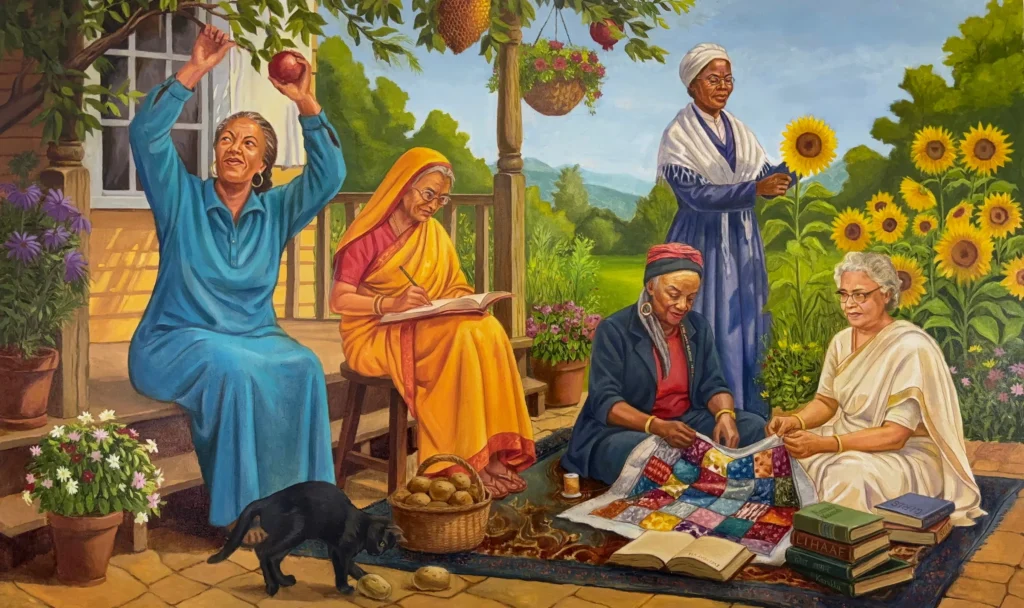
Saviya Lopes, सध्या काय चाललय? / What are you up to these days? (L-R: Toni Morrison, Babytai Kamble, Faith Ringgold, Sojourner Truth, Ismat Chughtai) 2025, Oil on Linen. Courtesy: Art and Charlie
Nevertheless, Lopes went to art school, and graduated in Painting. In her fourth year, she joined the Clark House Collective – an artist collective in Mumbai. The company of fellow artists like Prabhakar Pachpute, Amol K. Patil, Yogesh Barve, Poonam Jain, Sachin Bonde and Sucheta Ghadge emboldened and empowered her practice – “there was so much I learned from these artists that I never learned in college, just by sharing a space with them.”
Textiles, Mixed-Media, Painting – A Journey Across Mediums
“I’ve always been inclined towards textiles because of my relationship with my grandmother, who used to make quilts. I created a quilt in collaboration with her for my final year project. I remember my professor dismissing it by stating that it’s not art, but craft. It frustrated me and made me question those arbitrary labels. Despite studying painting, I consciously chose to not paint for a while and focused on drawing and textiles to push my work and inquiry further.”
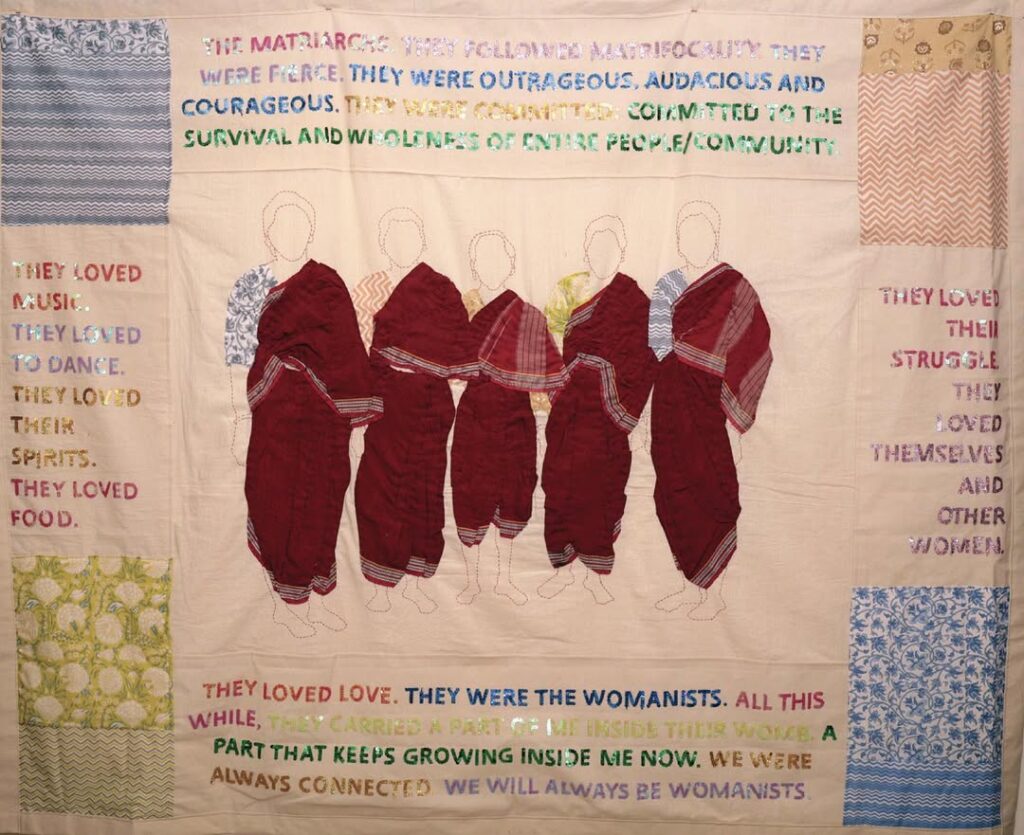
Saviya Lopes, Quilt Us A Story. Courtesy: Art and Charlie
Lopes deepened her tryst with textile and mixed-media works as a result of her professor’s statement. She drew inspiration from family archives, and enjoyed an intense period of creation where she produced a number of works. Her solo show Dear Tereza… at Art and Charlie was an intergenerational ode to her grandmother and womanhood rooted in textile and mixed-media works.
“Until now my practice examined how materials hold social, political, and embodied knowledge. It’s very recently that I felt like something was missing. So, I returned to painting – not as a departure from this research, but as an extension of it.” Thus, emerged You, Me & Them: A Body That I Used To Know – Lopes’ most recent solo show at Art and Charlie.
Community, Identity & Memory
Lopes belongs to the East Indian Catholic community and her work excavates memory through archives and lived experience. She astutely says: “I cannot jump into someone else’s story before decoding my own.” From collaborative projects with her grandmother and speculative interpretations of photographs and letters left by the grandfather she never met, she reframes the stories from her family and community into larger political narratives.
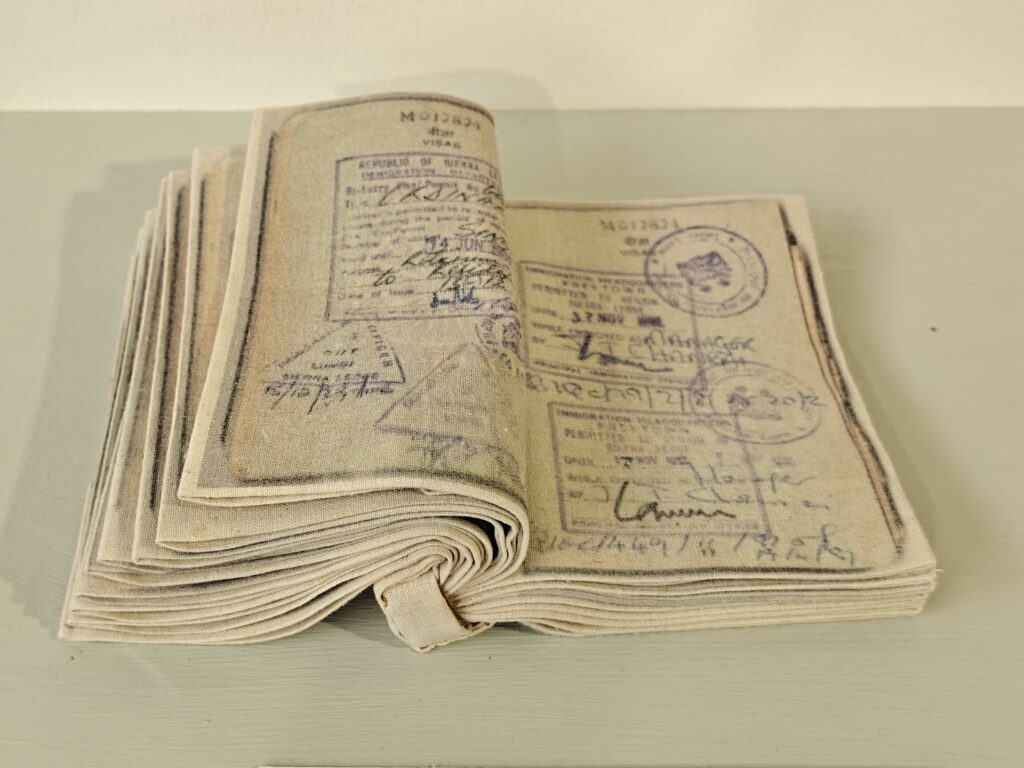
Saviya Lopes, Where Brown Meets Blue at Autopoiesis: A Song for Resuscitation
“There was a lot of appreciation for my work with my grandmother, but over time it progressed more slowly due to age-related constraints, unfolding at a pace shaped by circumstance. I respect her time, space and limits. There’s a very thin line after which your subject can become an object, and I would never want to do that to her. Even when I document her in my works, I never portray her directly. That would turn her completely into an object.”
Authorship & Collectivity
Lopes believes that solo authorship is a concept bogged down with colonial and patriarchal connotations. “The knowledge I possess has been acquired from everyone else who came before me. Through embroidery, crafts and textiles, I’m repeating the work of my mother and grandmother -– it’s like an indigenous mother tongue I keep re-learning.”
She often returns to Carol Hanisch’s seminal feminist essay: The Personal is the Political. “While creating the works in the four walls of a studio, they feel personal to me. But I also know that there will be a point when the works have to leave the studio. They will no longer be my story alone, but someone else’s as well.”
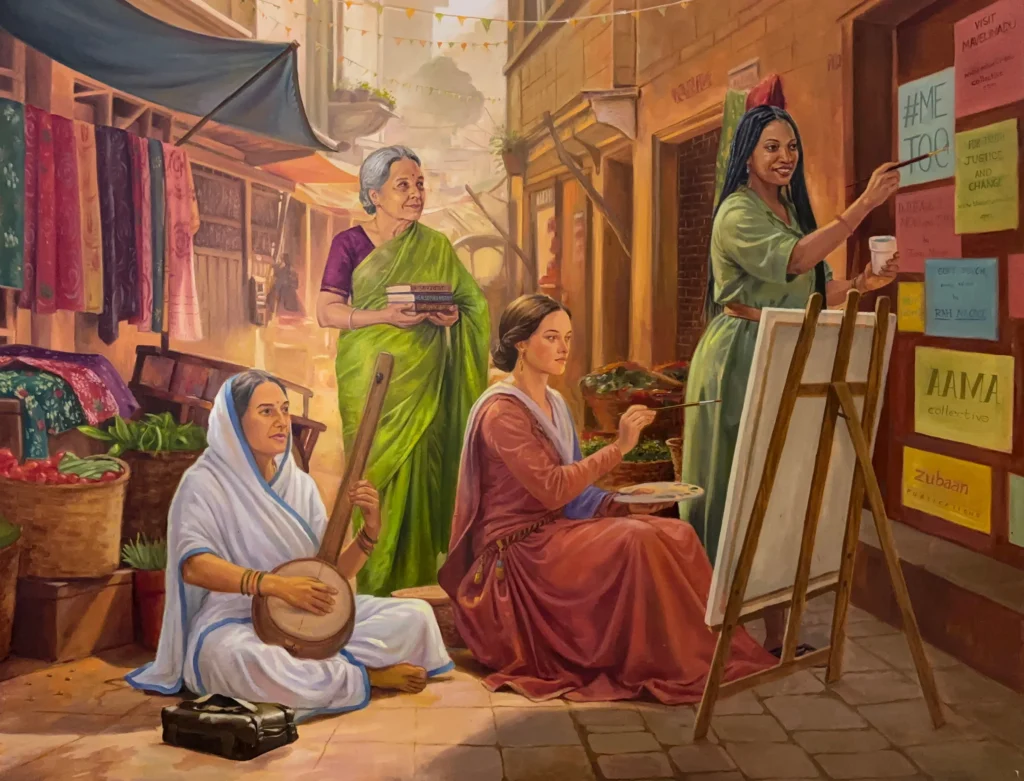
Saviya Lopes, एकता बाजार / Street of solidarity (L-R: Sant Soyarabai, Urmila Pawar, Artemisia Gentileschi, Tarana Burke), 2025, Oil on linen canvas
She points out that a solo show is never really a solo effort. She created the paintings of A Body That I Used to Know in a bright, airy house shared by other creatives, artists and feline friends. The paintings began in her journals and in her studio/room, before migrating down the staircase into common spaces. At every step, various hands pitched in to ensure the paintings reached gallery walls and the outside world. “I cannot dismiss them as just friends or well-wishers. They are very much a part of my growth and development as an artist and a person. They create a safe space within which questions, critique and solidarity can arise.”
By subverting the individualistic framework of creating art, there is an inherently feminist element to Lopes’ embrace of collective authorship and co-creation. Her works and practice become a fertile ground for intergenerational knowledge, personal histories and lived experiences to interact with each other. She summarises this in a simple, clear statement: “I’m not the origin point. I’m merely a vessel.”
Reimagining the Political Lives of Women
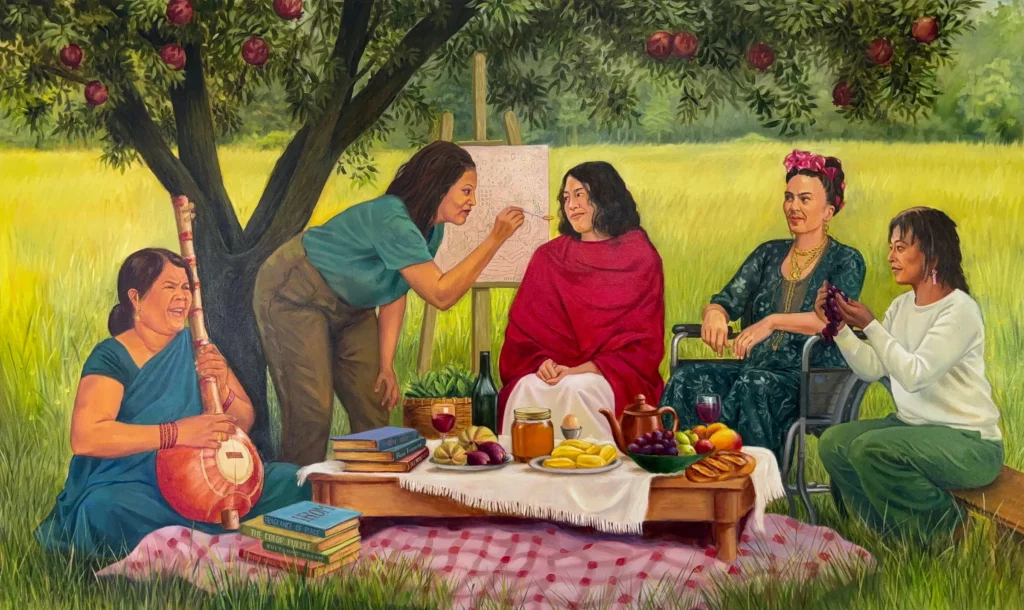
In her recent show A Body That I Used To Know, Lopes reimagined iconic feminist icons from across geographies and generations in moments of rest and leisure. Women who have never interacted with each other now shared space, laughter and conversations across tables, living rooms and streets. Lopes mentions: “I’ve read a work by each of the women seen in this solo.”
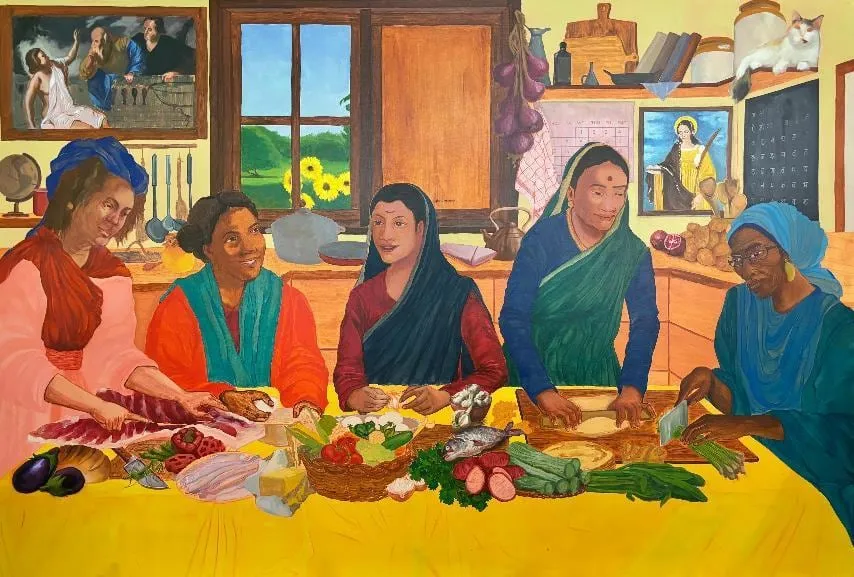
Saviya Lopes, Kaay Banvaicha? 2024. Courtesy: Art and Charlie
Artemisia Gentileschi, bell hooks, Savitri Bai, Tarabai Shinde, and Sojourner Truth are seen connecting within the frame of a single painting. “These five women came together for example, because I felt like they were declaring something through their works. We’ve always seen them in moments of labour — that’s how history has portrayed women’s political struggles. I wanted to show them in moments of rest, with the freedom they deserve.”
Lopes wanted to reposition the political lives of women with respect to their representation in popular media. “I wanted to give them a place that they had been denied for so long.”
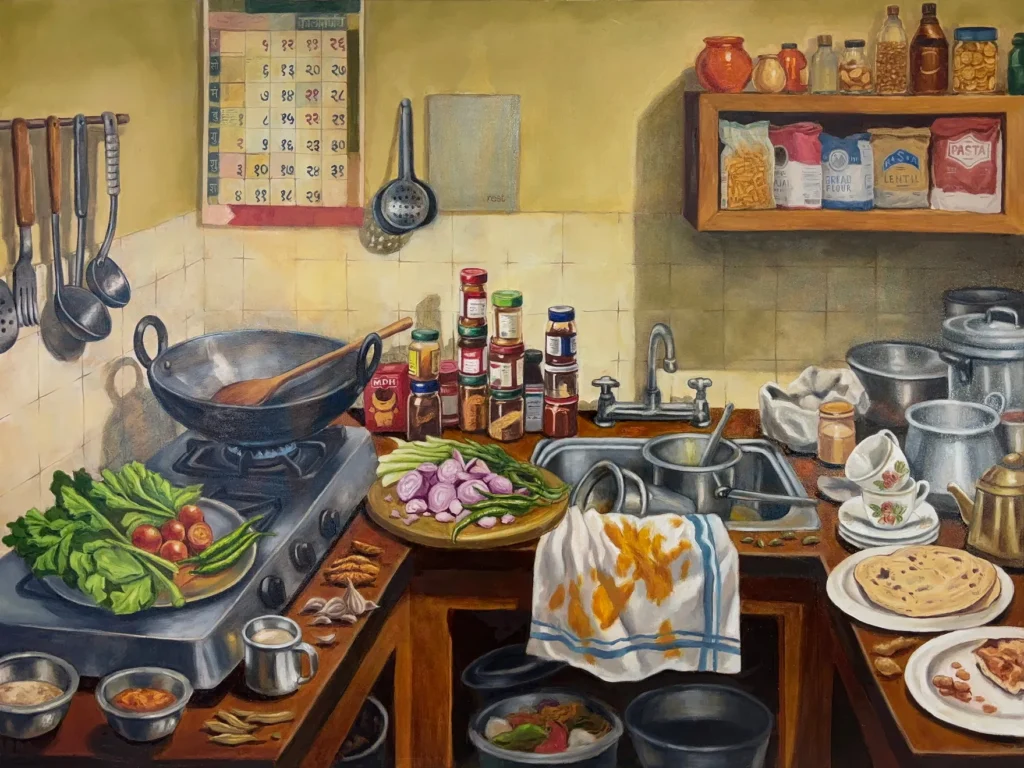
Saviya Lopes, I used to know the kitchen as a site of gathering… but now I also know it as a site of invisible labour, 2025, Oil on Linen. Courtesy: Art and Charlie
In a world where radical is synonymous with ‘edgy’ or ‘gritty’, Lopes is nurturing a gentle revolution that nudges us to listen, remember and re-connect. She documents the daily resistance of women who weave, sing, fight and forge their ways through the world.
Through her eyes, we see ourselves not as separate and scattered, but resilient because we have each other.
