

The Politics of Seeing: Supranav Dash’s ‘Marginal Trades’
25 | 03 | 26
Written by Tina Wadhawa
Somewhere between a painted canvas and a fashion photograph, a quiet restlessness began to take shape. The images were precise, composed, and technically assured, but they seemed to stop just short of something more enduring. They held form and surface with clarity, yet lacked the kind of encounter that allows an image to linger – where the subject is not simply framed, but fully met.
That absence would come to define a shift in Supranav Dash’s practice, a gradual move away from the constructed polish of fashion photography towards a more deliberate, human-centred approach. This shift comes fully into focus in Marginal Trades, developed between 2011 and 2015, where the photograph is no longer an act of capture but a careful negotiation of presence, attention, and power where the subject stands, holds their ground, and, crucially, looks back.
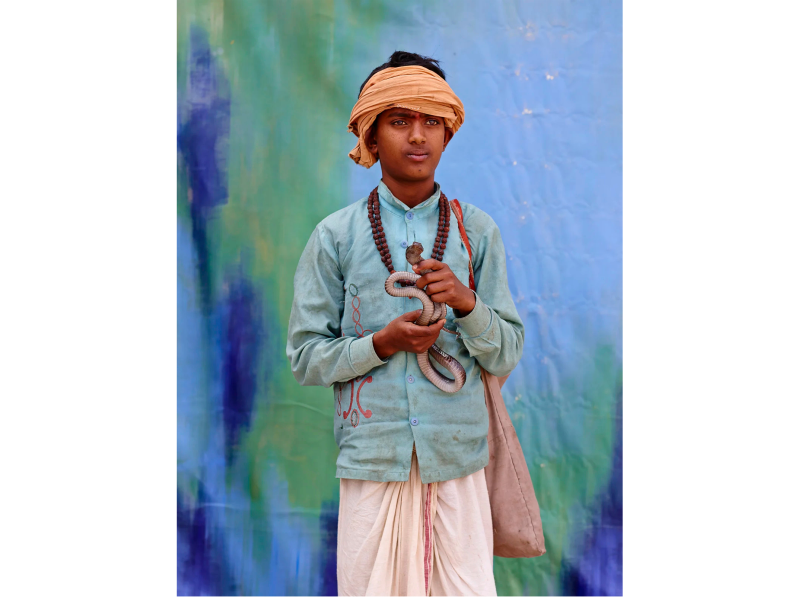
NOMADIC SNAKE CHARMER (8TH GENERATION), $15 WEEKLY, 2014
A Practice Formed in Transition
Dash’s early years in West Bengal unfolded against a backdrop where a future in the arts felt uncertain. Trained in painting, he turned to commercial photography out of necessity, assisting fashion and advertising photographers before eventually running his own studio. Between 2001 and 2009, his work moved across advertising, fashion, and editorial spaces, refining a visual language that was controlled and exacting, yet increasingly distant from the kind of connection
he was searching for.
“My life path has been very challenging to say the least,” he reflects. What persisted through this period, however, was a belief in the value of artistic training, even if access to it remained out of reach for years. It was only later, after a prolonged delay, that he would formally study photography in the United States.
That distance from formal education, and the years spent working within commercial systems, began to surface as a quiet dissatisfaction. “I was missing the deep connection with my subjects. I yearned for ‘soul connect’,” he says. In response, he began travelling, photographing people in less mediated contexts, and allowing space for encounters that felt less prescribed. “That changed something in me forever and the way I think and create images today.”
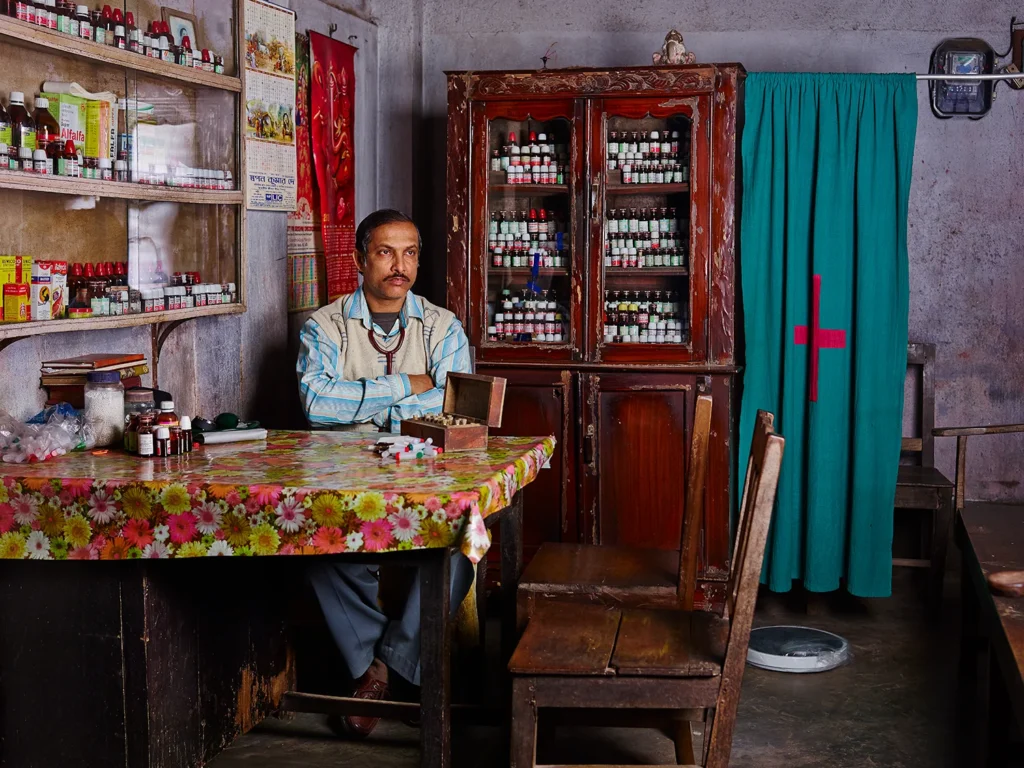
HOMOEOPATHIC DOCTOR, $50 WEEKLY, 2013
Relearning How to See
A more formal shift took place when Dash enrolled at the School of Visual Arts in New York. There, his engagement with the histories of photography and art introduced him to practices that would reshape his thinking. The works of Eugène Atget, Irving Penn, and August Sander offered a way of seeing that was structured yet attentive,
grounded in both form and social context.
“So much so, that I changed my core focus… from specialisation in fashion to documentary
practices,” he notes.
At the same time, Dash began to reflect on earlier photographic traditions, particularly colonial ethnographic projects such as The People of India (1868-75). These archives revealed how photography could function not only as documentation, but as a tool of classification and control. Any contemporary engagement with portraiture, especially in the context of labour and caste, would need to reckon with this history.
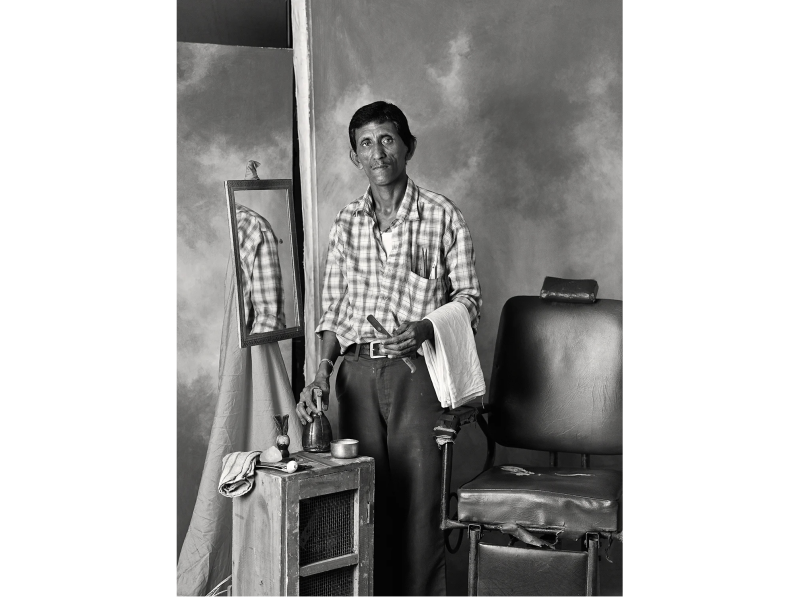
STREET BARBER II, $26 WEEKLY, 2012
The Memory That Became a Method
The origins of Marginal Trades, for Dash, are deeply personal. During his time in New York, he recalls waking from a dream populated by figures from his childhood: a barber, a rickshaw puller, a household helper, a locomotive driver. These were not abstract subjects, but people whose labour had shaped the world around him. “Thus, a connection of the dots happened that fine morning,” he says.
That memory is inseparable from the influence of his maternal grandfather, Jogesh, a senior employee at the Eastern Railway office in Asansol and, as Dash describes him, “a true Gandhian” who instilled in him a deep sense of empathy for working-class people. Early encounters with tradesmen like Dani, the barber who came home each morning to shave his grandfather, stayed with him long before Marginal Trades took form as a thesis project.
What began as personal memory gradually expanded into a larger inquiry into labour and visibility. Marginal Trades emerges from this intersection of memory and observation, not simply as a documentation of professions, but as an attempt to recognise the lives and labour that often remain at the margins of visibility.
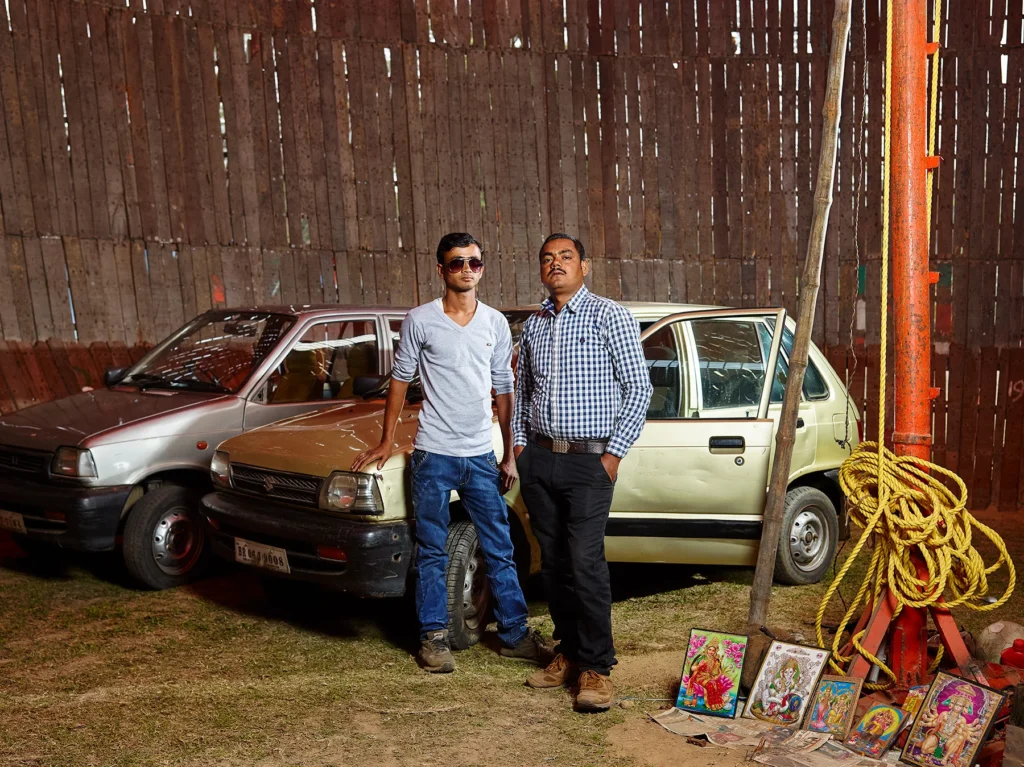
DEATH-WELL CAR DRIVERS, $60 WEEKLY, 2015
Constructing the Image, Redistributing Power
When Dash began photographing, he made a decision that would shape the entire body of his work. The subjects would not be photographed within their working environments. Instead, they would be brought into a studio space constructed within a bazaar. “By removing the environmental visual cues, every person and profession gets an equal weight to make them feel ‘seen’, appreciated and dignified.”
The studio itself was deliberately modest. Hand-painted backdrops referenced his training in painting, while daylight-balanced lighting ensured a sense of familiarity for those unaccustomed to being photographed. The camera remained fixed, allowing for a slower and more considered process. “My subjects were allowed to own up the studio space… They would share their stories and information without being rushed or forced.”
Dash rejects the detached, observational mode that has often defined representations of marginalised communities. “Power needed to be given back to these tradespeople,” he says, emphasising the need to photograph “with sensitivity and dignity.”
The consistent use of eye-level compositions becomes critical here. The subject is no longer positioned as an object of observation, but as an active participant within the frame. “They had the power to ‘gaze back’ at the society which has marginalised them until now.”
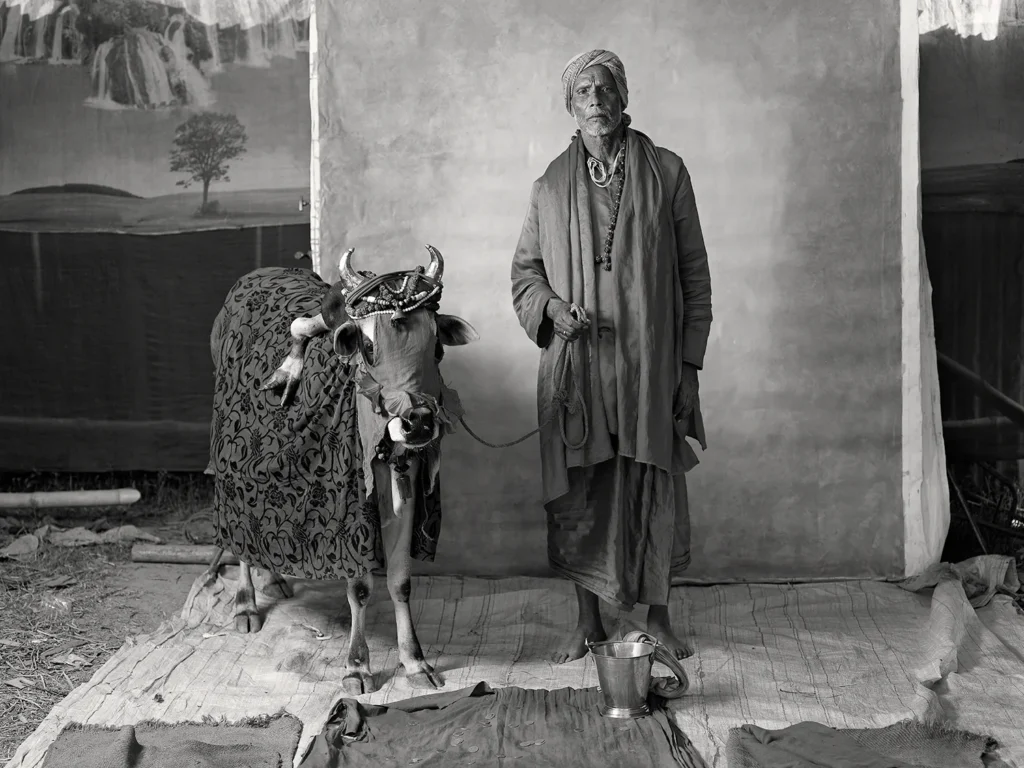
HOLY (RITUALISTIC) BRAHMIN WITH DEFORMED COW, $20 WEEKLY, 2012
Labour, Caste, and the Weight of Context
Alongside the portraits, Dash includes details of each subject’s weekly income, grounding the images within an economic reality that cannot be overlooked. “Most of the people I photographed were okay with sharing all the information I asked,” he notes, even as some remained understandably hesitant.
This gesture situates the work within a larger historical and social framework. In India, trades and professions have long been intertwined with caste, passed down across generations with little mobility. As economic structures shift and traditional systems begin to fracture, many of these practices are either disappearing or becoming unsustainable. “The modern generation abandoned their ancestral trades… due to insufficient incomes, to escape the caste stereotyping,” he explains.
The inclusion of income data resists any attempt to aestheticise labour without acknowledging its conditions. The photograph, in this sense, holds both presence and precarity within the same frame.
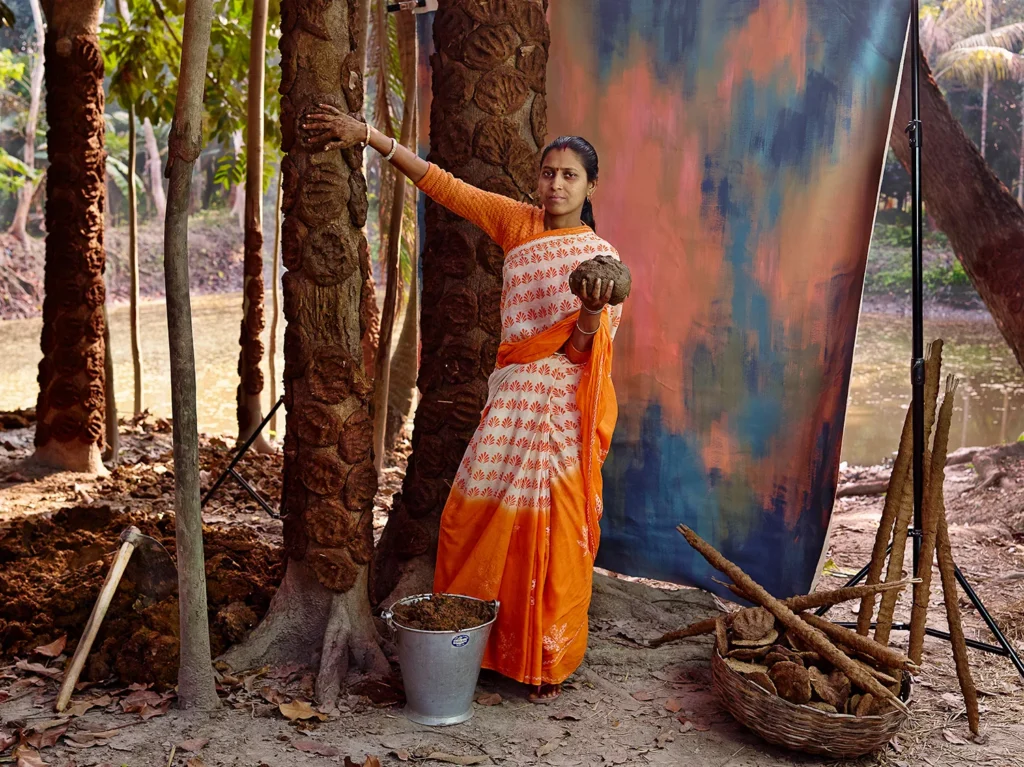
COW-DUNG CAKES MAKER/SELLER, $7 WEEKLY, 2013
On Depth, Dignity, and Time
For Dash, the strength of an image lies in its ability to sustain depth, dignity, and detail. These are not qualities that can be imposed, but ones that must be built through attention and time.
“We can add all the elements to make an image… strong; but then can we really be sure?” he reflects. “We do the best we can, put it out there and hope that the viewers… will get it.”
In an era defined by the rapid circulation of images, the question of what endures becomes increasingly significant. Over a decade after its initial release, Marginal Trades continues to resonate. Its first exhibition in India came years after it had already circulated internationally, a reminder that the life of an image does not unfold all at once.
“When I hear… that my ‘Marginal Trades’ images are still stuck with them… I feel that
something right was achieved then.”
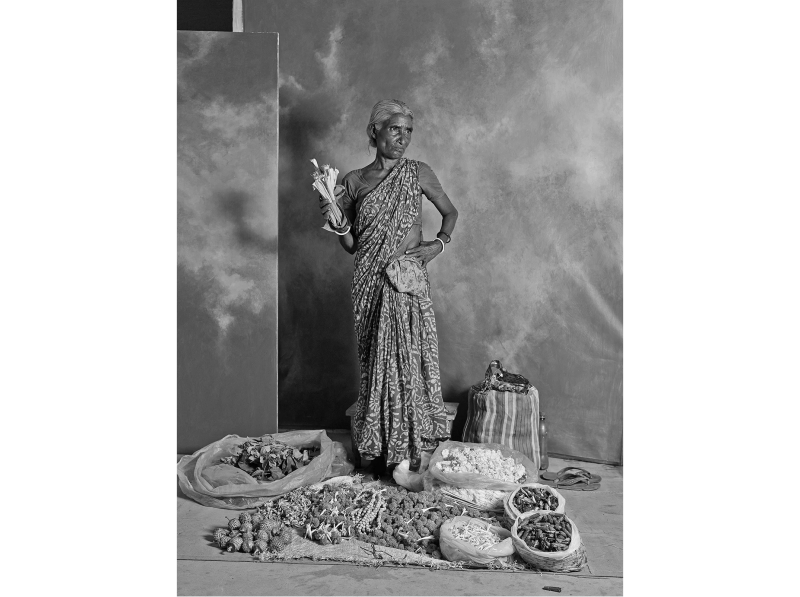
FLOWER (FOR WORSHIP) SELLER, $30 WEEKLY, 2013
What Marginal Trades makes evident is that documentary photography is never neutral. It is shaped by decisions that carry both aesthetic and ethical weight. In reconfiguring the conditions under which his subjects are photographed, Dash does more than document a set of professions – he repositions the terms of visibility itself.
As his first documentary project, Marginal Trades laid the groundwork for Dash’s thought process, technical language, and emotional approach to human-centred image-making. A dignified approach towards his sitters has remained constant across his practice, whether in New Mothers, where he photographs women just after childbirth in maternity wards, In The Pursuit of Happiness, which engages with domestic spousal abuse and the misuse of IPC 498A laws, or Eros And Its Discontents, where he creates performative studio portraits of members of the LGBTQIA+ community. If the subjects and contexts shift, the underlying ethic does not.
“I have the highest regard for the working class people,” he says, and more broadly, for those whose lives are too often shaped by neglect, exploitation, or structural violence. What endures across his work is a refusal to treat vulnerability as spectacle. Instead, the portrait becomes a space in which dignity is not granted from above, but carefully protected.
To stand in front of these portraits is to be met with a gaze that does not yield easily. The subjects do not ask for attention, nor do they perform for it. They occupy the frame with a quiet certainty, holding their tools, their histories, and their presence with equal clarity. In doing so, they resist disappearance, and insist instead on being seen, fully and without reduction.